 blog
blog
Professional Grounds Keeping Services 2026: What to Expect
Table of Contents
- What Professional Grounds Keeping Services Cover in 2026
- Council Compliance Grounds Maintenance: What Property Managers Need to Document
- Commercial Lawn Mowing in the Dandenong Ranges: Contracts and Service Levels
- Weed Management in Victoria: Declared Species and Practical Control
- Battery-Powered Grounds Maintenance: Noise, Emissions and Results
- How Grounds Keeping Pricing and Estimates Work
- Choosing a Grounds Keeping Provider in 2026
- Frequently Asked Questions
Last Updated: October 7, 2026
What Professional Grounds Keeping Services Cover in 2026
Professional grounds keeping in 2026 covers far more than mowing. A proper program manages turf, trees, hedges, weeds, paths and green waste as one coordinated plan across the seasons.
Grounds keeping is the scheduled care of a property's outdoor areas: lawns, garden beds, hedges, trees, pathways and hard surfaces. It differs from one-off landscaping because the work repeats on a cycle, adjusted for growth rates and site conditions.
Three property types drive most of the work across the Dandenong Ranges and outer south-east Melbourne:
- Residential properties: standard blocks with lawns, hedges and garden beds, usually visited fortnightly through spring and summer.
- Commercial grounds: retail, schools, body corporate and industrial sites needing documented, insured work on a fixed schedule.
- Acreage and lifestyle blocks: larger parcels with slashing, overgrowth management and long boundary lines.
Residential, Commercial and Acreage Scopes
Each scope carries different expectations. A suburban block in Belgrave or Upwey needs regular lawn mowing and garden maintenance.
Commercial sites add paperwork. Property managers want evidence of attendance, insurance details and a clear scope of works. That documentation matters more than the mowing itself on some contracts.
The common thread is a maintenance plan. Teams that book seasonal work in advance get consistent results.
Council Compliance Grounds Maintenance: What Property Managers Need to Document
Council compliance grounds maintenance means keeping grass and vegetation within local requirements and proving the work was done. Across Victorian councils, grass height rules and fire hazard notices apply to vacant land, rental properties and commercial sites. The trigger point varies by council, so check your own council's local laws rather than assuming a figure.
For fire hazard inspections, councils in bushfire-prone areas issue notices requiring fuel reduction before the declared Fire Danger Period. Work typically includes:
- Slashing long grass and removing cut material
- Clearing gutters and rooflines of leaf litter
- Reducing fine fuels near structures and fences
For rental and commercial properties, keep a simple record for each visit: date, works completed, and photos of the finished area. If a council or owner queries compliance, that record answers the question quickly.
Commercial Lawn Mowing in the Dandenong Ranges: Contracts and Service Levels
Commercial lawn mowing in the Dandenong Ranges runs on contracts, not casual bookings.
A workable commercial scope usually covers:
- Fortnightly or weekly mowing through the growing season
- Edging, whipper snipping and blowing down of pathways
- Hedge trimming on a set cycle rather than on request
The growing season here runs roughly September to April. Growth slows sharply from May through August, so many contracts step down to monthly visits over winter.
| Scope Element | Typical Frequency | What It Covers |
|---|---|---|
| Mowing and edging | Fortnightly in season | Turf, edges, pathways |
| Hedge trimming | Every 6-10 weeks | Boundary and feature hedges |
| Weed control | Monthly spot checks | Beds, paths, hard surfaces |
| Green waste removal | Every visit | All cut material off site |
For larger commercial grounds, an hourly rate with a machine and operator is common. For regular mowing on a defined area, a per-visit rate based on site condition is simpler to budget.
Weed Management in Victoria: Declared Species and Practical Control
Weed management in Victoria starts with identification. Blackberry and ragwort are declared noxious weeds, and landowners have a legal responsibility to control them. Both spread quickly across the Dandenong Ranges, particularly on neglected acreage and along fence lines.
Blackberry forms dense thickets that choke out pasture and create a fire risk when dry. Ragwort is toxic to livestock and produces thousands of seeds per plant, so control before flowering matters most.
Practical control follows a sequence:
- Identify the species and confirm whether it is declared.
- Cut and remove the bulk of the growth.
- Treat regrowth at the right stage rather than spraying mature plants.
- Revisit the site to catch what returns.
Mulching and chipping cut material on site reduces what leaves the property, and the mulch suppresses new growth in garden beds.
Battery-Powered Grounds Maintenance: Noise, Emissions and Results
Battery-powered grounds maintenance has moved past being a compromise.
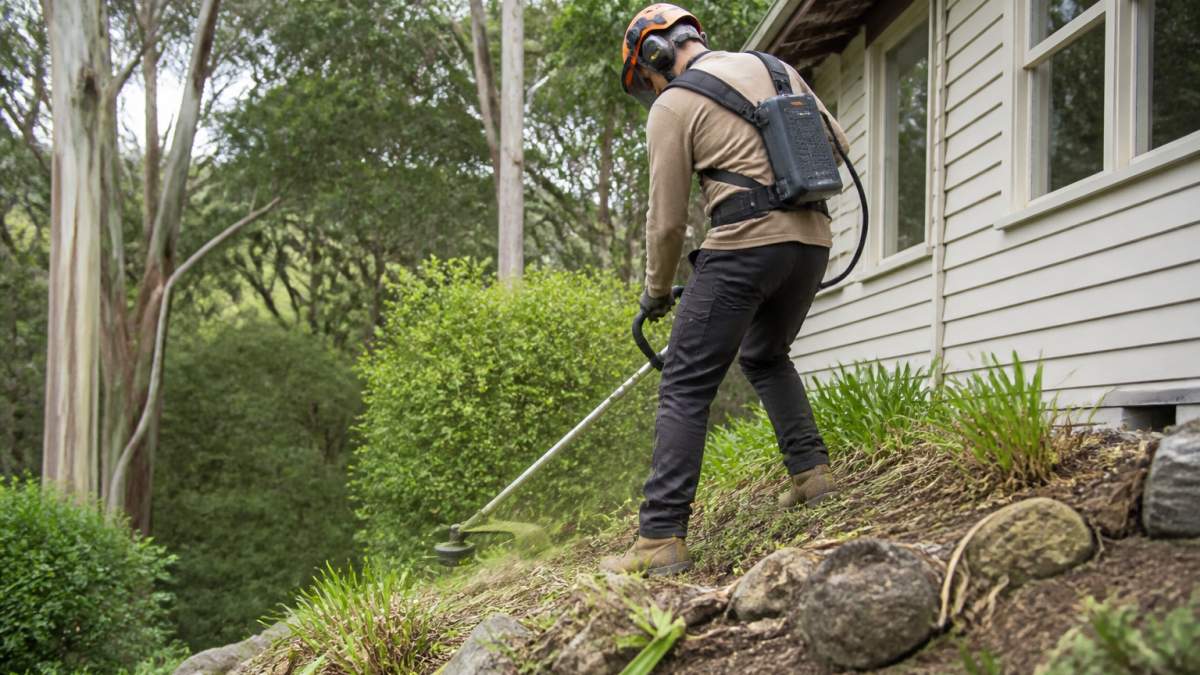
The practical difference shows on quiet streets and in shared spaces.
Battery still has limits on sustained heavy work over large acreage. Long slashing runs on steep ground can outlast a single battery set, so a provider needs enough spare packs.
Terra Maintenance runs quiet battery equipment across its residential and commercial work, which suits the tree-lined streets and close neighbours typical of towns like Olinda, Sassafras and Tecoma.
How Grounds Keeping Pricing and Estimates Work
Grounds keeping pricing in 2026 is built from four inputs: site area, site condition, access, and visit frequency. No single rate fits every property, and any provider offering a firm figure without seeing the site is guessing. The sections below cover how a defensible estimate is assembled and what a service package should include.
The four cost drivers
- Area. Turf is measured in square metres. Hedges are measured in linear metres and by height. Slashing on acreage is measured in hectares or by time on the machine.
- Condition. A maintained block and one untouched for two years are different jobs. The first visit on a neglected site can take two to three times as long as the ongoing visit.
- Access. Steep and sloping blocks across the Dandenong Ranges slow every pass. Narrow gates, retaining walls, garden beds cut into the slope, and soft clay soils after rain all add time. A block that looks small from the road can take longer than a flat half-acre.
How a service package is structured
Most providers price regular grounds keeping as a package rather than a list of separate tasks. A typical package for a residential block includes:
| Package element | What it covers | How it is priced |
|---|---|---|
| Mowing and edging | Turf cut, edges trimmed, paths blown down | Per visit, based on area and access |
| Hedge trimming | Boundary and feature hedges cut to shape | Per linear metre, or included on a set cycle |
| Weed control | Beds, paths, hard surfaces, fence lines | Per visit or per spot-treatment round |
| Green waste removal | All cut material taken off site | Included in the rate, or a separate tipping charge |
| Seasonal tasks | Fertilising, mulching, leaf and bark litter clearing | Priced per task or folded into a seasonal plan |
For commercial and body corporate sites, the package is usually written into a service-level agreement with a fixed visit frequency and defined scope. For acreage, slashing and overgrowth work is often priced hourly with a machine and operator, because time on site varies with growth and terrain.
How an estimate is built
A site visit is the only way to produce a figure that holds. The provider should walk the block, measure turf and hedge runs, check access, note site condition, and confirm how often the client wants the work done. From there, the estimate separates the first visit from the ongoing rate.
A common pattern is:
- First visit. Higher, because it includes catch-up work: long grass, overgrown hedges, accumulated leaf litter, and weed removal.
- Ongoing rate. Lower, because the site is now on a cycle and each visit is maintenance rather than recovery.
- Seasonal adjustments. Growth slows from May through August, so many agreements step down to monthly visits over winter and return to fortnightly from September.
Ask for the estimate to separate the first visit from the ongoing rate, and to state whether green waste removal is included. A property that has been neglected for a couple of years will always cost more to bring back than it will to maintain, and a clear split stops that surprise later.
What a fair estimate should include
- A written scope of works, not just a number.
- The visit frequency and the season it applies to.
- Whether green waste removal and tipping are included.
Terra Maintenance provides free estimates based on a site visit, so the figure reflects the actual block rather than an average. The estimate can be adjusted on site if the scope changes, and the client sees the split between the first visit and the ongoing rate before any work starts.
Choosing a Grounds Keeping Provider in 2026
Choosing a grounds keeping provider in 2026 comes down to verification, not price alone. Directory results and social posts list providers but give you little to check them against. The framework below covers what to verify, what to compare, and what to look for in a service agreement before work starts.
What to verify before booking
- Insurance. Ask for the certificate of currency for public liability cover. A provider working on your property without current cover leaves the risk with you.
- ABN and business structure. A registered business is easier to hold to a contract than a cash-only operator. Check the ABN against the Australian Business Register.
- Qualifications and licences. For herbicide use on declared weeds such as blackberry and ragwort, ask who holds the appropriate chemical user accreditation. For tree work near powerlines or on significant trees, ask about the relevant tickets.
What to compare across providers
Comparing providers on price alone hides the differences that matter. Compare them on:
| Comparison point | What to look for |
|---|---|
| Scope of works | Written, itemised, and matched to your site |
| Visit frequency | Stated for the growing season and for winter |
| Green waste | Included in the rate or billed separately |
| Response time | How quickly they attend an extra or urgent visit |
| Documentation | Visit records, photos, and insurance on request |
| Consistency | Same operators each visit, or a rotating crew |
A cheaper operator who skips visits in a wet week leaves you chasing the work yourself. On a fire hazard notice, that delay has real consequences, because the council re-inspection does not wait for the provider to catch up.
What to look for in a service agreement
A workable agreement for regular grounds keeping should state:
- The visit frequency and the season it applies to.
- The scope of works, including what is not included.
- How green waste is handled and where it goes.
For commercial and body corporate sites, the agreement should also set out how attendance is recorded and how records reach the property manager. That documentation matters more than the mowing itself on some contracts.
Red flags
- A firm price given over the phone without a site visit.
- No certificate of currency available on request.
- No written scope, only a verbal agreement.
Terra Maintenance is owner operated by Harrison and Jesse Ashford, fully insured with $20 million public liability cover, and has maintained more than 320 local properties. The same operators return to each site, and GPS-optimised scheduling keeps visits on a predictable cycle.
For a property that needs regular lawn mowing, hedge trimming or full overgrowth management, the estimate starts with a look at the site.
Frequently Asked Questions
What documentation should a commercial grounds maintenance provider supply?
For commercial sites, ask for a written scope of works, a service schedule, and job records showing dates and tasks completed. Where a council fire hazard notice or grass height rule applies, request dated before-and-after photographs and a short compliance statement. Confirm the provider holds current public liability insurance and can supply a certificate of currency. Keep these records on file so you can respond quickly if a council officer or insurer requests evidence of ongoing maintenance.
How often should lawns be mowed during a Victorian spring?
Spring growth across the Dandenong Ranges and outer south-east Melbourne typically pushes kikuyu, couch and buffalo lawns hard, so most properties need mowing every 10 to 14 days from September through November. Sloping blocks and irrigated lawns can grow faster. Leaving it longer than three weeks risks scalping, which stresses the turf and lets weeds establish. A fixed fortnightly schedule through spring, then adjusted for summer and winter growth, keeps the lawn even without heavy catch-up cuts.
Which weeds in the Dandenong Ranges need professional management?
Blackberry and ragwort are declared noxious weeds in Victoria and both are common across the Dandenong Ranges, along with ivy, tradescantia and soursob in damp shaded areas. Blackberry spreads by seed and root suckers, so slashing alone makes it denser. Ragwort is toxic to livestock and spreads rapidly across paddocks. Effective control combines repeated cutting, correct timing before seeding, and targeted follow-up. For larger infestations, a weed management plan with scheduled visits produces better results than a single clean-up.
Is battery-powered equipment genuinely quieter than petrol tools?
Battery-powered mowers, trimmers and blowers run noticeably quieter than petrol equivalents, with far less vibration and no exhaust fumes. That matters on smaller blocks where neighbours are close, and on acreage where an operator may be running tools for hours. Output is comparable for standard mowing, hedging and cleanup work on residential and light commercial sites. Very heavy overgrowth and large-scale slashing may still call for heavier machinery, which a provider can advise on after assessing the site.