 ultimate-guide
Acreage Mowing Cost Per Acre: 2026 Pricing Guide
Table of Contents
- What Drives Acreage Mowing Cost Per Acre
- How Terrain Complexity Changes Your Acreage Mowing Cost
- Equipment and the Real Cost of Getting It Wrong
- Acreage Lawn Care Frequency and Seasonal Pricing
- Bushfire Fuel Reduction Mowing and Council Grass Height Compliance
- How to Get an Accurate Acreage Mowing Estimate
- Verdict: What Acreage Mowing Should Cost You
- Frequently Asked Questions
Last Updated: October 4, 2026
What Drives Acreage Mowing Cost Per Acre
Acreage mowing cost per acre is not a single fixed figure. At Terra Maintenance, we estimate every acreage property individually because two blocks of identical size in the Dandenong Ranges can take wildly different times to finish.
Here is the honest answer up front: most acreage mowing is priced on time and complexity, not on a flat rate per acre.
Below, we break down the variables that move the number, so you can sanity-check any estimate you receive.
Hourly Rate vs Per-Acre Pricing
Two pricing models dominate acreage work, and they suit different properties.
Hourly pricing charges for time on site. It is the fairest model for complex blocks because the operator is paid for the work actually required.
Per-acre pricing charges a set amount for each acre cut. It works when the ground is open, relatively flat and consistently maintained.
Ask which model an operator uses and why.
Property Size and Access
Size sets the baseline, but access decides whether the baseline holds.
- Gate width and driveway condition: If a ride-on mower or slasher cannot get through, everything slows down or changes equipment.
- Distance from the street: Long driveways add travel and setup time.
- Fencing and stock: Livestock must be moved and gates managed, which adds labour.
A one-acre block with clear access and a two-acre block with a narrow gate and a steep entry can take similar time. That is why we assess access before discussing any figure.
How Terrain Complexity Changes Your Acreage Mowing Cost
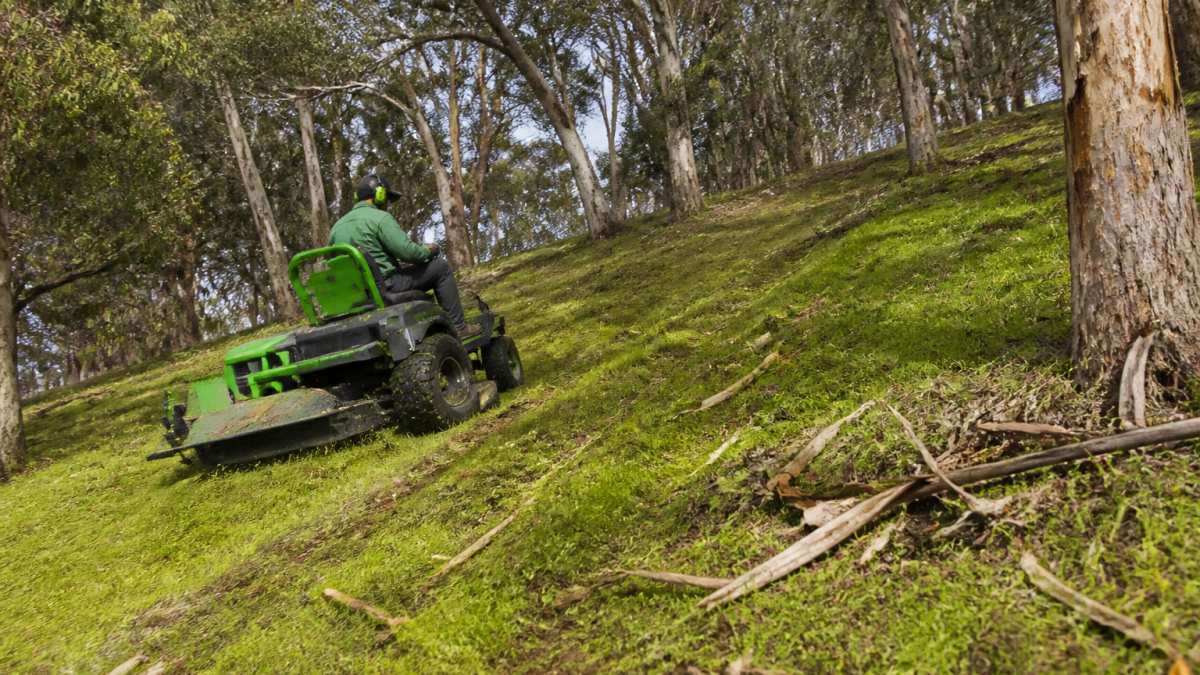
Terrain is the single biggest variable in acreage mowing cost. A slasher on open ground covers far more area per hour than a ride-on mower working around trees, stumps and steep banks.
Slope, Obstacles and Remnant Vegetation
Local blocks in the Dandenong Ranges often carry a mix of steep grades, remnant gum trees, rocky outcrops and old fence lines. Each of these slows the work:
- Slope: Steep ground must be cut slowly, sometimes in one direction only, and some grades are unsafe for certain machines.
- Obstacles: Every tree, stump and garden bed means stopping, reversing and repositioning.
- Remnant vegetation: Long grass around native plantings needs brush cutting rather than a mower, which is slower per square metre.
- Fallen bark and leaf litter: Gum leaf and bark drop builds up quickly and must be managed, not just driven over.
A block with 30 scattered trees is not a 30-tree problem. It is a slower, more careful job across the whole area.
Equipment and the Real Cost of Getting It Wrong
Equipment choice determines how fast a property can be cut, and speed determines cost. The right machine for the job is cheaper overall than a cheap machine doing the wrong job badly. This is the part of acreage mowing most guides skip, and it is the single best explanation for why estimates for the same block can vary so widely.
Large acreage generally needs one of three approaches, and each one has a different effective coverage rate.
| Machine | Best For | Effective Coverage | Main Limitation |
|---|---|---|---|
| Ride-on mower | Maintained, relatively even lawns and open areas | Moderate on open ground, slows sharply around obstacles | Struggles on rough, overgrown or very steep ground |
| Zero-turn mower | Open areas with scattered obstacles and garden beds | Fast around obstacles on even ground | Not suited to very steep or rough ground |
| Slasher or tractor-mounted cutter | Long grass, rough paddocks, heavier overgrowth | High on open, flat paddocks | Leaves a rough finish, not suitable for a house lawn |
Why Coverage Rate Matters More Than Machine Size
A bigger machine is not automatically faster on your block. The coverage rate depends on how much of the block the machine can actually reach at speed.
- Open flat paddock: a slasher can work at full width and cover ground quickly.
- Sloping block with scattered gums: the same slasher slows on grades, lifts around stumps and repositions constantly, so effective coverage drops.
- Neat house lawn with garden beds: a zero-turn shines because it turns tightly and keeps speed up between obstacles.
- Rough, long grass around native plantings: a ride-on will struggle and leave a poor finish, so a brush cutter or slasher is needed, which is slower per square metre.
This is why an operator who arrives with the wrong machine will either take much longer than expected or leave a finish you are not happy with. Both outcomes cost you more in the long run.
Green Waste and the Hidden Cost
There is also the matter of green waste removal. Large volumes of clippings and cuttings need to be dealt with, and that is a separate consideration from the mowing itself. If you want the material chipped and returned to the garden, ask about that upfront. If it is being removed, ask where it goes and whether the cost is included in the estimate.
Acreage Lawn Care Frequency and Seasonal Pricing
Acreage lawn care frequency is the quiet multiplier on cost. Cutting a block every two weeks keeps grass manageable and each visit relatively quick. Letting it run for two months turns a routine job into overgrowth management, which takes longer and costs more per visit.
Frequency choices usually look like this:
- Fortnightly: The standard for maintained lawns through the growing season.
- Monthly: Suitable for slower-growing periods or lower-maintenance areas.
- Seasonal or one-off: Clean-ups for overgrown blocks, pre-sale preparation or fire preparation.
Spring Growth and Southern Hemisphere Timing
Growth here follows southern hemisphere seasons. Spring runs September to November and drives the fastest growth of the year, especially with kikuyu, couch and buffalo lawns.
Summer (December to February) brings heat stress and, in many years, dry periods that slow growth. Autumn (March to May) sees another growth flush before winter.
Seasonal pricing follows this pattern. In peak growth, more visits are needed and each visit takes longer. In winter, the workload drops.
Bushfire Fuel Reduction Mowing and Council Grass Height Compliance
Fuel reduction and compliance are two of the most common reasons acreage owners book mowing, and both carry deadlines that do not move.
Bushfire fuel reduction mowing is the practice of cutting grass and reducing ground fuel on a property to lower fire risk ahead of the fire danger period. For blocks in bushfire overlay areas, this is not optional.
Council Grass Height Compliance
Councils across the outer south-east set maximum grass heights on private land, and they can issue notices requiring a property to be cut. If you are renting out a property or managing it remotely, a compliance notice can arrive without warning.
The practical points:
- Check your council's specific grass height rule, as it varies between municipalities.
- Act before the fire danger period, not during it, when contractors are booked out.
- Keep records of the work, including dates and photos, as proof of compliance.
- Declared noxious weeds such as blackberry and ragwort must also be controlled, and mowing alone will not always solve them.
If you need documentation that work has been completed to a compliance standard, ask for it at the time of booking. It is far easier to arrange upfront than to chase later.
Country Fire Authority fire safety and fuel reduction guidance
How to Get an Accurate Acreage Mowing Estimate
An accurate estimate comes from a site assessment, not a phone description.
Here is how we approach it, and what you should expect from any provider:
- Site assessment: Someone walks the block, looks at slope, obstacles, access and grass length.
- Access check: Gate widths, driveway condition and any hazards are noted.
- Scope agreement: You confirm what is included, such as mowing, edging, brush cutting and green waste removal.
- Frequency decision: Fortnightly, monthly or one-off, agreed before work starts.
- Written estimate: A clear figure with the scope attached, so there are no surprises.
Use this checklist to compare providers fairly:
- Did they visit the site before giving a figure?
- Is the estimate in writing with the scope listed?
- Is green waste removal included or extra?
- Is the frequency specified?
That last point matters more than most people expect. Consistency is what keeps a mowing schedule working.
| Factor | Why It Moves the Price | What to Ask |
|---|---|---|
| Terrain and slope | Slower cutting, different equipment | What machine will be used? |
| Obstacles and trees | Constant stopping and repositioning | How many obstacles did you count? |
| Access and gates | Setup and travel time | Can the mower reach all areas? |
| Grass length | Overgrowth takes longer than routine cut | Is this a one-off clean-up? |
| Frequency | More visits in peak growth | Fortnightly or monthly? |
| Green waste | Removal and disposal is separate work | Is removal included? |
| Compliance | Deadlines and documentation | Can you provide proof of work? |
For a property that has been neglected, expect the first visit to cost more than the ongoing schedule. Clearing years of growth is a different job from maintaining a block that is already under control.
Agriculture Victoria guidance on declared noxious weeds
Verdict: What Acreage Mowing Should Cost You
The properties that cost the least to maintain are the ones on a consistent schedule.
Terra Maintenance is owner operated by Harrison and Jesse Ashford, fully insured, and services acreage and lifestyle properties across the Dandenong Ranges and outer south-east Melbourne.
Get a free estimate from Terra Maintenance and get a clear figure based on your block, not a generic rate.
Frequently Asked Questions
What factors influence the cost of mowing acreage in Victoria?
The main factors are property size, terrain complexity, grass height and density, access, and how often you need the service. A flat, open block with short grass costs less per acre than a steep, rocky site with scattered trees and long grass. Travel time and green waste removal also affect the final figure. Every property is different, so a site assessment gives you the most accurate picture of what your block will cost.
How does terrain complexity affect acreage mowing estimates?
Steep slopes slow mowing significantly because operators must reduce speed and sometimes switch to specialised equipment. Obstacles such as trees, rocks, garden beds and fence lines require trimming and brush cutting, which adds labour time. A block with 30 percent slope and scattered vegetation can take two to three times longer than a flat, clear paddock of the same size. Always mention slope and obstacles when requesting an estimate.
Are there specific council requirements for grass height in the Dandenong Ranges?
Yes. Many councils in the Dandenong Ranges and outer south-east Melbourne enforce grass height limits on residential and rural blocks, particularly during the fire danger period. Requirements vary by council and zone, so check with your local council for the exact rules that apply to your property. If you need documentation to show compliance, ask your mowing provider whether they supply before-and-after records or service reports.
How often should acreage be mowed during the Victorian spring growth season?
Spring runs September to November in Victoria, and this is when kikuyu, couch and buffalo lawns grow fastest. Most acreage blocks need mowing every two to three weeks during this period to keep grass at a manageable height. Letting grass grow too long between visits increases the cost of each mow because the equipment works harder and green waste volume rises. A regular schedule keeps costs predictable and results consistent.
Why is battery-powered equipment preferred for acreage maintenance?
Battery-powered equipment produces less noise, which matters on acreage blocks where neighbours are close and noise carries. It also has no fuel odour, no exhaust emissions and lower vibration, making it suitable for quiet residential areas and environmentally sensitive properties. Modern battery mowers and brush cutters handle acreage work effectively when matched to the right task. For heavy slashing or land clearing, petrol equipment may still be needed for the toughest sections.