 how-to
Is Battery Powered Lawn Equipment Quiet? Noise Levels Explained
Table of Contents
- Battery Powered Lawn Equipment Noise: What to Expect
- Battery vs Petrol Lawn Mower Noise: Decibel Comparison
- Battery Lawn Mower Noise Level by Equipment Type
- Battery Leaf Blower Noise: What to Know
- How to Reduce Lawn Mower Noise
- Battery Mower Performance in Thick Grass and Runtime Limits
- Local Noise Rules and Considerate Mowing Hours
- Frequently Asked Questions
Last Updated: October 9, 2026
Battery Powered Lawn Equipment Noise: What to Expect
Yes, battery powered lawn equipment is quiet. A battery mower typically runs at around 75 to 85 decibels, while a petrol mower sits closer to 95 to 100 decibels.
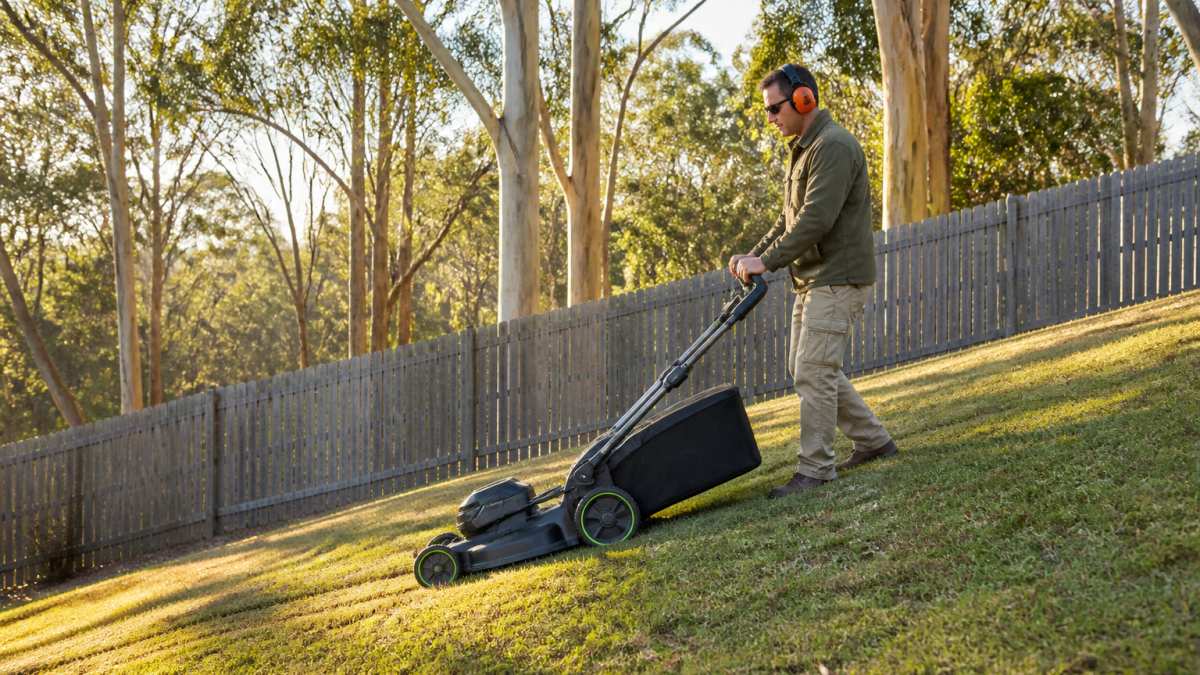
At Terra Maintenance, we run battery gear across the Dandenong Ranges and outer south-east Melbourne. On a quiet street in Emerald or Belgrave, a battery mower is background noise.
Below, we break down real noise levels by equipment type, what affects them, and how to keep the peace with your neighbours.
How Electric Motors Differ from Petrol Engines
An electric motor has far fewer moving parts than a petrol engine. No combustion, no exhaust, no cooling fan roaring to keep a hot engine alive. The result is a steady hum instead of a mechanical roar. Petrol engines also produce exhaust emissions at the point of use, which is why many councils and strata groups now favour battery equipment for regular maintenance.
Noise Character: Motor Whine vs Engine Roar
Loudness is only half the story. The character of the sound decides how far it travels and how much it annoys.
- Petrol engine: low-frequency roar, carries further, harder to ignore
- Electric motor: higher-pitched whine, fades faster over distance
- Blade noise: the cutting deck or line trimmer head, present on both types
Battery vs Petrol Lawn Mower Noise: Decibel Comparison
The table below shows typical sound levels for common equipment. Treat these as general ranges. Real readings vary with the machine, the load on the motor, the surface being cut, and how far the sound has travelled.
| Equipment | Petrol (dB) | Battery (dB) | Perceived difference |
|---|---|---|---|
| Push mower | 95-100 | 75-85 | Roughly twice as loud |
| Ride-on mower | 95-105 | 80-90 | Noticeably louder |
| Leaf blower | 95-110 | 65-80 | Large gap |
| Line trimmer | 95-105 | 70-80 | Large gap |
| Hedge trimmer | 90-100 | 65-75 | Large gap |
Measured Decibels at the Operator and Property Boundary
At the operator's ear, a battery mower usually reads 75 to 85 decibels. Ten metres away, that often drops to 60 to 70 decibels. At the property boundary, it can fall to 55 to 65 decibels, close to normal conversation. Petrol equivalents hold their volume much further out, which is why a petrol mower three houses away still disrupts a phone call while a battery mower often does not.
Distance is not the only variable. A few practical points explain why two people can measure the same mower and get different numbers:
- Load: a battery mower in long kikuyu or wet buffalo draws more current and the motor note rises. The same mower on a short, dry couch lawn stays at the lower end of its range.
- Measurement position: a reading at the operator's ear includes blade noise and motor whine. A boundary reading is mostly motor tone, because higher frequencies fade faster over distance.
- Surface and surroundings: a mower on a hard path or against a timber fence reflects sound back, while the same mower on open grass with a dense shrub screen reads lower at the boundary.
How the Numbers Translate to a Real Block
On a typical sloping block in Belgrave or Upwey, the operator often works above or below the neighbouring house. Sound travels downhill more readily than uphill, so a battery mower on an upper terrace can still be audible at the lower boundary.
On a standard quarter-acre block, a battery mower at mid power typically sits below the level of normal conversation at the fence line. That is why battery equipment suits close-set residential streets and bushland-interface blocks.
Where the Gap Narrows
Battery equipment is not uniformly quiet. A battery ride-on under load in tall spring growth can reach the low 90s, and a high-output battery blower at full throttle can approach the lower end of the petrol blower range. The advantage is largest for push mowers, line trimmers and hedge trimmers, and smallest for ride-ons and large blowers at maximum output.
Battery Lawn Mower Noise Level by Equipment Type
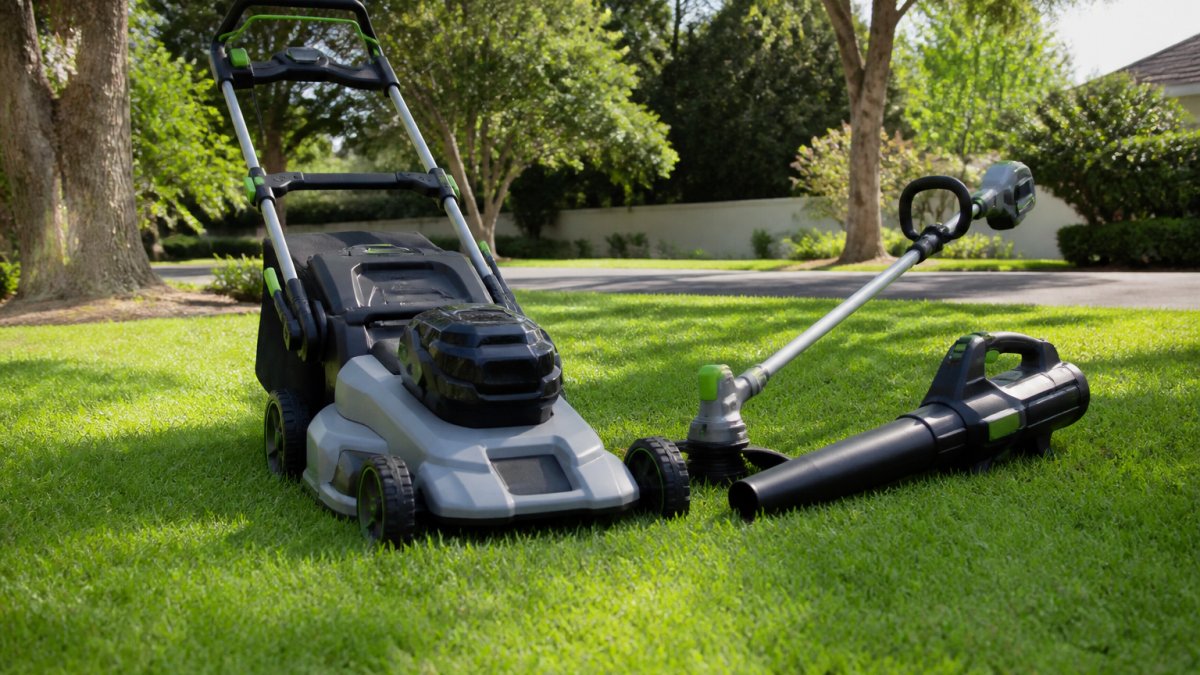
Not all battery gear is equally quiet. Mowers, blowers and trimmers each produce a different sound profile.
- Battery mower: 75-85 dB, mostly motor whine plus blade contact with grass
- Battery leaf blower: 65-80 dB, dominated by air movement
- Battery line trimmer: 70-80 dB, motor plus line hitting grass
Cordless vs Corded Electric Mowers
Corded electric mowers are usually slightly quieter than cordless models, because they run at a fixed power output. Cordless mowers vary motor speed with load, so they can spike briefly in thick grass. Cordless wins on freedom and safety: no cord to drag across a sloping block, no risk of cutting a lead on a steep Dandenong Ranges property.
Battery Leaf Blower Noise: What to Know
Battery leaf blowers are the quietest powered option for clearing gum leaves and bark litter. Most run at 65 to 80 decibels, well below the 95 to 110 decibels of a petrol blower. The noise comes from moving air, not the motor, so a bigger, faster blower is louder regardless of power source. For most residential clean-ups, a mid-range battery blower is more than enough.
How to Reduce Lawn Mower Noise
You can cut noise without buying new gear. Small changes to timing, technique and maintenance make a real difference, and most also extend battery runtime and improve cut quality.
Technique and Timing
- Mow when grass is dry. Wet grass strains the motor, raises current draw and lifts the motor note. A dry lawn in January or February cuts faster and quieter than the same lawn after overnight dew.
- Do not let the lawn get away from you. Long grass forces the mower to work harder. Regular cuts through spring, when kikuyu and couch grow fastest, keep the load low and the sound steady.
- Use a lower power setting where the job allows. Many battery mowers have an eco mode that holds the motor at a fixed, quieter speed. Reserve the high setting for thick patches.
Maintenance That Lowers Noise
- Keep blades sharp. A dull blade tears grass rather than cutting it, adding a rhythmic knock and forcing the motor to work harder.
- Balance the blade. An unbalanced blade produces vibration that reads as extra noise and shortens bearing life.
- Check for loose parts. A rattling deck, loose catcher or worn wheel bearing can be louder than the motor itself.
Equipment-Specific Notes
- Mowers: the dominant sound is blade contact with grass, not the motor. A sharp blade on a dry lawn is the biggest noise reduction available.
- Line trimmers: the line hitting grass and edging against fences is the loud part. Reduce head speed where the model allows, and avoid running the line against hard surfaces.
- Leaf blowers: noise comes from air movement, so a smaller nozzle and lower throttle setting make a real difference. For gum leaf and bark litter on paths and driveways, a rake or broom is quieter and often faster on small areas.
Noise Character and Perceived Loudness
A lower decibel reading does not always mean a sound that is easier to live with. Pitch and pattern matter. A steady electric hum is easier to tune out than the irregular roar of a petrol engine, even when readings are close.
Battery equipment is not silent. Motor whine, blade noise and air movement are all present. On a still winter morning in Monbulk or Cockatoo, a battery mower at the boundary is clearly audible, just far less carrying than petrol.
Hearing Protection and Safe Exposure
Safe exposure depends on both loudness and time. The louder the equipment, the shorter the safe listening window.
- Under 85 dB: generally safe for extended periods
- 85-95 dB: limit continuous exposure, use protection
- Above 95 dB: hearing protection is essential
Battery gear mostly sits in the lower bands. Petrol gear sits in the higher ones. A battery ride-on or a large blower at full output can still reach the middle band, so match protection to the tool and the duration, not just the power source.
Considerate Mowing Hours
Most Victorian councils set noise rules under the Environment Protection Act 2017, administered by the EPA.
As a general rule, avoid mowing before 8am and after 8pm on weekends and public holidays. On weekdays, most residents expect mowing to start after 7am and finish before dark.
If you are managing overgrowth to meet a fire hazard notice, or clearing declared noxious weeds such as blackberry and ragwort, schedule the work around noise-sensitive hours where the deadline allows.
Battery Mower Performance in Thick Grass and Runtime Limits
Battery mowers handle most residential lawns well. Kikuyu, couch and buffalo are manageable when you mow regularly and keep the deck clean.
Thick, wet or overgrown grass is the real test. A battery mower slows down and drains its battery faster in heavy growth. Runtime typically ranges from 30 to 60 minutes per charge, depending on the model and the load.
- Regular mowing: battery mower keeps pace easily
- Neglected growth: expect slower progress and shorter runtime
- Steep or sloping blocks: higher load, faster drain
Local Noise Rules and Considerate Mowing Hours
Terra Maintenance handles lawn mowing and overgrowth management across the Dandenong Ranges, using battery equipment to keep noise low. We are fully insured and owner operated by Harrison and Jesse Ashford.
Frequently Asked Questions
Is battery-powered lawn equipment quieter than petrol equipment?
Yes, significantly. Battery-powered mowers typically run at 75 to 85 decibels, while petrol mowers often exceed 95 decibels. That difference matters because decibels are logarithmic: a 10 decibel reduction roughly halves perceived loudness. Battery leaf blowers and trimmers show similar gaps. The quiet operation comes from electric motors producing less vibration and no exhaust pulses. For properties in quiet areas or near neighbours, battery equipment reduces disturbance without sacrificing cutting performance for typical residential lawns.
How loud are battery-powered lawn mowers?
Most battery lawn mower noise levels fall between 75 and 85 decibels at the operator's ear. Robotic mowers run quieter still, often under 60 decibels. Reel mowers, whether manual or battery-assisted, are the quietest option. The exact figure depends on motor design, blade speed, deck material and grass conditions. Thick grass increases load and noise slightly. At the property boundary, levels drop further with distance. This range sits below the threshold where most councils restrict mowing hours, though checking local rules is wise.
Are battery-powered leaf blowers quiet?
Battery leaf blower noise typically ranges from 60 to 75 decibels, noticeably lower than petrol models that can exceed 90 decibels. The sound is also different: a higher-pitched whine rather than a low engine roar. Perceived loudness depends on both decibels and frequency. While quieter, battery blowers still produce enough noise to disturb neighbours if used at 7am on a Sunday. Considerate timing and avoiding full throttle near boundaries keep the peace. Hearing protection is still sensible for extended use.
Can battery-powered lawn equipment be used early in the morning?
Battery equipment is quiet enough for early use in many cases, but local noise rules still apply. Some councils restrict power tool use before 7am or 8am on weekends. Battery mowers at 75 to 85 decibels are less likely to trigger complaints than petrol models, but they are not silent. If you mow at 7am with a battery mower, nearby bedrooms may still hear it. Check your council's guidelines and consider your neighbours' schedules. Mid-morning is often the safest compromise.
Quiet equipment only solves part of the problem. Timing, technique and the right gear for the job all matter, especially on steep, heavily planted blocks where noise carries. Terra Maintenance runs battery-powered mowing, hedge trimming and overgrowth management across the Dandenong Ranges and outer south-east Melbourne, with GPS-optimised scheduling and a focus on council compliance. Get a free estimate and see how quiet, reliable grounds care fits your property.